Metropolitan Museum of Art Construction Las Vegas Strip 1965
| Desert Inn Hotel and Casino | |
|---|---|
 | |
 The Desert Inn in 1968 | |
| | |
| Location | Paradise, Nevada, U.S. |
| Accost | 3145 Due south Las Vegas Blvd |
| Opening date | April 24, 1950 |
| Endmost date | August 28, 2000 (August 28, 2000) |
| Theme | Desert |
| No. of rooms | 715 |
| Total gaming space | 35,000 sq ft (3,300 m2) |
| Signature attractions | Desert Inn Golf Course |
| Casino type | State |
| Owner | 1964–1967 Moe Dalitz 1967–1988 Howard Hughes 1988–1993 Kirk Kerkorian 1993–1998 ITT / Sheraton Hotels and Resorts 1998–2000 Starwood 2000 Steve Wynn[1] |
| Previous names | Wilbur Clark's Desert Inn, Sheraton Desert Inn |
| Coordinates | 36°07′43″Northward 115°ix′59″Westward / 36.12861°Northward 115.16639°Westward / 36.12861; -115.16639 Coordinates: 36°07′43″N 115°9′59″W / 36.12861°N 115.16639°W / 36.12861; -115.16639 |


The Desert Inn, also known every bit the D.I., was a hotel and casino on the Las Vegas Strip in Paradise, Nevada, which operated from April 24, 1950, to August 28, 2000. Designed by architect Hugh Taylor and interior design past Jac Lessman, it was the fifth resort to open on the Strip, the get-go four beingness El Rancho Vegas, The New Frontier, the still-operating Flamingo, and the now-defunct El Rancho (then known as the Thunderbird). It was situated betwixt Desert Inn Route and Sands Avenue.
The Desert Inn opened with 300 rooms and the Sky Room restaurant, headed past a chef formerly of the Ritz Paris, which once had the highest vantage point on the Las Vegas Strip. The casino, at ii,400 square anxiety (220 m2), was one of the largest in Nevada at the time. The nine-story St. Andrews Tower was completed during the first renovation in 1963, and the 14-story Augusta Tower became the Desert Inn's main belfry when it was completed in 1978 along with the seven-story Wimbledon Belfry. The Palms Tower was completed in 1997 with the 2d and terminal renovation. The Desert Inn was the start hotel in Las Vegas to feature a fountain at the entrance. In 1997, the Desert Inn underwent a $200 million renovation and expansion, but later it was purchased for $270 million by Steve Wynn in 2000, he decided to demolish it and build a new hotel and resort and casino. The remaining towers of the Desert Inn were imploded in 2004. Today, the Wynn and Encore are now where the Desert Inn once stood.
The original performance venue at the Desert Inn was the Painted Desert Room, later the Crystal Room, which opened in 1950 with 450 seats. Frank Sinatra made his Las Vegas debut there on September 13, 1951, and became a regular performer. The property included an 18-hole golf game course which hosted the PGA Tour Tournament of Champions from 1953 to 1966. The golf game course is now a role of the Wynn resort.[2]
History [edit]
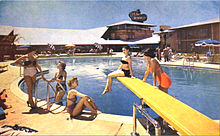
Young women at the hotel pool in 1955

The hotel was situated at 3145 Las Vegas Boulevard South, between Desert Inn Road and Sands Avenue.[iii] The original proper noun was Wilbur Clark's Desert Inn. Wilbur Clark, described by Frank Sinatra biographer James Kaplan as a "onetime San Diego bellhop and Reno craps dealer",[4] originally began building the resort with his brother in 1947 with $250,000, only ran out of money. Author Hal Rothman notes that "for nearly two years the framed structure sat in the hot desert sun, looking more like an aboriginal relic than a nascent casino".[five] Clark approached the Reconstruction Finance Corporation for investment, but information technology was struggling financially. In 1949, he met with Moe Dalitz, the head of the notorious Cleveland gang, the Mayfield Road Mob, and Dalitz agreed to fund 75% of the project with $1.3 million, and construction resumed.[5] Much of the financing came from the American National Insurance Company (ANICO),[half dozen] though Clark became the public frontman of the resort while Dalitz remained quietly in the background every bit the principal owner. The resort would eventually exist renamed Desert Inn and was chosen the "D.I." past Las Vegas locals and regular guests.[7]
The Desert Inn opened formally on April 24, 1950,[8] [ix] at a two-twenty-four hour period gala which was heavily publicized nationally. Journalists from all of the major newspapers and magazines were invited, and the hotel paid $v,700 to cover air tickets. 150 invitations were sent out by Clark to VIPs with a credit limit of $10,000. About half the attendees at the opening were from California and Nevada. At the opening show in the Painted Desert Room were performers such as Edgar Bergen and Charlie McCarthy, Vivian Blaine, Pat Patrick, The Donn Arden Dancers, Van Heflin, Abbott and Costello, and the Desert Inn Orchestra, led past Ray Noble.[10] In attendance were a number of mafiosi, including Black Bill Tocco, Joe Massei, Sam Maceo, Peter Licavoli, and Frank Malone in a gala which Barbara Greenspun believed marked the starting time of heavy involvement of the mafia in the development of Las Vegas.[xi] Sidney Korshak was one of its early on investors.[11]
The Desert Inn became known for its "opulence" and top-notch service.[12] The first manager of the Desert Inn had previously worked every bit the manager at the Clift Hotel in San Francisco.[seven] Lew and Edie Wasserman were frequent guests of the hotel.[thirteen] During the 1950s, the hotel often hosted the Knuckles and Duchess of Windsor, Winston Churchill, Adlai Stevenson, Senator John F. Kennedy, and former President Harry S. Truman.[12]
In the mid 1940s and early 1950s the city and its Sleeping accommodation of Commerce worked to keep the Vegas nickname of the "Diminutive City" going to attract tourists.[14] [15] [16] After the Desert Inn opened, so called "bomb parties" famously took place in the hotel's panoramic Heaven Room, where patrons could view the detonations from a relatively safe distance while drinking Atomic Cocktails.[17] [xviii]
In 1959, Lawrence Wien, owner of New York Metropolis'due south Plaza Hotel purchased the hotel, merely signed a direction deal for Clark to remain every bit manager.[19] In the early 1960s, the mafia-financed casino hotels of the Las Vegas Strip and Nevada came nether shut scrutiny by the FBI, and they placed increased pressure level on the Nevada Gaming Control Board to force the mobsters out of Las Vegas. Later Sam Giancana was spotted on the premises of Frank Sinatra'southward Cal Neva Social club & Casino at Lake Tahoe, his gambling license was removed by the Board and he was forced to sell up and forfeit his share in the Sands Hotel and Casino.[20] [21] The Desert Inn faced similar scrutiny by the FBI, attracting controversy at the same fourth dimension for the involvement of Dalitz and his mobster associates,[22] but simultaneously called for the prosecution of the FBI for illegal wiretapping.[23] In 1964, Clark sold his remaining share in the hotel to Dalitz and concern associates Morris Kleinman, Thomas McGinty and Sam Tucker. He died of a heart set on the following year. The bell captain of the Desert Inn, Jack Butler, remembered Clark: "Wilbur was the greatest guy. Without him this town never would've got off the basis. Anybody came into the club just to run into him and he was all over the postcards. He was the only boss who would agree to have his picture taken".[24]
The Desert Inn'southward nigh famous guest, businessman Howard Hughes, arrived on Thanksgiving Solar day 1966, renting the hotel'south unabridged top 2 floors.[25] After staying past his initial ten-day reservation, he was asked to leave in December so that the resort could accommodate the high rollers who were expected for New year's Eve. Instead of leaving, Hughes started negotiations to buy the Desert Inn.[26] On March 27, 1967,[27] Hughes purchased the resort from Dalitz for $6.two one thousand thousand in greenbacks and $7 meg in loans.[25] This was the first of many Las Vegas resort purchases by Hughes, including the Sands Hotel and Casino ($14.six million) and the Borderland Hotel and Casino ($23 one thousand thousand).[26] However, Hughes refused to include the PGA Bout Tournament of Champions in the bargain, so Dalitz moved the tournament to his Stardust Resort and Casino in 1967 and 1968.[28]
The reclusive Hughes continued to live in his penthouse suite at the Desert Inn for iv years, never leaving his 250 square anxiety (23 mtwo) bedroom. Usually unclothed, he spent his time "negotiating purchases and business organisation deals with the defunction fatigued and windows and doors sealed shut with tape", and did not allow anyone from the hotel staff to come up in and make clean his room.[25] On the eve of Thanksgiving 1970, he was removed from his room on a stretcher and flown to the Bahamas.[26] After Hughes'southward death in 1976, the hotel remained nether the Summa Corporation, which completed the extensive renovation that he had ordered.[10] Summa sold the hotel to Kirk Kerkorian and the Tracinda Corporation in 1986, and it became known as the MGM Desert Inn. Kerkorian sold it to ITT-Sheraton in 1993 for $160 million.[10]
Modern history [edit]
In 1992, Frank Sinatra celebrated his 77th birthday at the hotel in an upshot that generated much media attention. Dick Taylor, the CEO of public relations firm Rogers & Cowan recalled: "We had the stars assemble in the casino's presidential suite and then took them in limos to the entrance of the hotel, where the press and hundreds of fans were gathered, like a Hollywood movie premiere. The stars were interviewed on the cherry carpet and in they went to the famed Crystal Room. It was a very big deal."[29]

The golf course, which was retained with the opening of Wynn Las Vegas
The property was sold to ITT Sheraton in 1993 for $160 million and renamed the Sheraton Desert Inn.[30] Four years after, in 1997, ITT Sheraton undertook a $200 meg renovation of the Augusta Tower and St. Andrews Belfry and expansion,[31] with the building and completion of the Palms Tower. The resort was returned to its historic name, The Desert Inn, dropping the Sheraton proper name, and was placed in the ITT Sheraton Luxury Drove partitioning. ITT Sheraton itself was sold the following twelvemonth to Starwood.[10] Due to losing money, Starwood immediately put The Desert Inn up for sale, and contracted a auction to Sun International Hotels Ltd. on May 19, 1999, for $275 million.[x] [32] The sale to Sunday International fell through the following March, however.[30] Also in 1999, Sinatra'due south and the Rat Pack's manor managers, Sheffield Enterprises Inc., sued the Desert Inn, claiming an infringement of rights in their use of Sinatra'south name and persona in its advertising and sales, including the words "Frank", "Ol' Blue Eyes", "the chairman of the Lath" and "The Rat Pack". Sinatra's manor specifically objected to their use in "billboard ad, marquees, alcoholic beverages and wine menus, and on the forepart and back of tee-shirts and caps at its gift shop" and alleged photographs of Sinatra and his signature on the walls behind the bar near the entrance to the Starlight Lounge of the Desert Inn.[33]
The Desert Inn celebrated its 50th anniversary on April 24, 2000. Celebrations were held for a week and a glory golf game tournament was held with the likes of Robert Loggia, Chris O'Donnell, Robert Urich, Susan Anton, Vincent Van Patten and Tony Curtis. Every bit role of the festivities, a fourth dimension capsule was buried in a granite burying chamber on Apr 25, to be reopened on April 25, 2050.[10] Three days later, on April 27, Steve Wynn purchased the resort from Starwood for $270 million. Wynn closed the Desert Inn at 2:00 a.thousand. on August 28, 2000.[10]
"Long time residents were stunned. They had endured the loss of the Dunes, the Sands, the Aladdin, the Landmark and the Hacienda but the loss of the Desert Inn seemed to hitting many of them on more personal level. Perchance it was that the Desert Inn had been the favored place for locals to go to for dancing and dining. Perhaps it was all the myth surrounding Wilbur Clark, Moe Dalitz and Howard Hughes. Or maybe information technology was that long time residents were beginning to realize that their boondocks was forever irresolute and would never again exist that small, wonderful Entertainment Capital letter of the World where you could see Sinatra and the Rat Pack or Elvis for dinner and drinks."
—Wilbur Clark's Desert Inn Hotel History[34]
On Oct 23, 2001, the Augusta Belfry, the Desert Inn'due south southernmost building,[35] was imploded to make room for a mega-resort that Wynn planned to build.[36] Coming a calendar month later the September 11 attacks, the implosion was marked with less fanfare than previous Las Vegas sabotage spectacles due to its similarity to the collapse of the Twin Towers.[37] Originally intended to be named Le Rêve, the new project opened as Wynn Las Vegas. The remaining two towers, the St. Andrews Belfry and Palms Belfry were both temporarily used equally the Wynn Gallery, spanning one,316 square feet (122.3 m2) to display some of Wynn's art collection.[38] The St. Andrews Tower and Palms Tower were finally imploded on November 16, 2004.[39]
Compages and features [edit]
The initial hotel, a $vi.v meg belongings fix in 200 acres, was designed past Hugh Taylor who was hired subsequently Wilbur Clark and Wayne McAllister could not agree on the pattern. Interiors were by noted New York architect Jac Lessman.[12] [40] The property conveyed the epitome of a "southwestern spa"[41] that was "half ranch house, half nightclub".[12] Information technology was built of "cinder blocks simply trimmed with sandstone and finished throughout the inside with redwood".[7] The logo of the hotel was a Joshua tree cactus.[4] The driveway into the hotel passed nether an "one-time-fashioned ranch sign" begetting the proper name Wilbur Clark's Desert Inn in scripted letters.[12] The Desert Inn was the showtime hotel in Las Vegas to feature a fountain at the archway. A "Dancing Waters" show involved the fountain jets choreographed to music.[vii]
The interior of the hotel was finished in redwood with flagstone flooring.[12] The public space included a registration area, a casino, two bars, a coffee shop, a restaurant, various commercial shops and services, and a broadcasting station for K-RAM radio.[12] Guest rooms were located in wings situated behind the main edifice, surrounding the figure-8 swimming puddle.[12] The hotel originally had 300 rooms, each outfitted with air conditioning with private thermostats.[7] [22]
The lounge was located in a three-story, glass-sided tower at the forepart of the hotel known as the Heaven Room, which was the largest structure on the Strip at the fourth dimension of its construction and commanded views of the mountains and desert all effectually, as well every bit overlooked the "Dancing Waters" characteristic.[12] [22] The Sky Room restaurant was headed past a chef formerly of the Ritz Paris.[seven]
The original performance venue at the Desert Inn was the 450 seat Painted Desert Room, after the Crystal Room, which opened in 1950 with 450 seats. Charles Cobelle created the handpainted murals, and a "ring car" was used to move the orchestra within the showroom.[42] Next door was a restaurant, the Cactus Room. The Kachina Doll Ranch was a supervised play area for guests' children.[43] The hotel had a ladies salon and health lodge from the outset.[8] Another performance venue at the hotel was the Lady Luck Lounge.[44]

The hotel starting time underwent renovation in the early 1960s, during which the St. Andrews Tower was built in 1963.[45] In the 1970s, the hotel underwent a $54-one thousand thousand renovation nether Howard Hughes, which resumed under the responsibility of the Summa Corporation after his death in 1976.[ten] The fourteen-story Augusta Tower became the Desert Inn'southward main tower when it was completed in 1978. The seven-story Wimbledon Tower contained duplex suites,[three] and resembled a modern version of a Mayan pyramid.[46] It disregarded the golf course and was built at the same fourth dimension,[47] bringing the total room count to 825.[48] By 1978, virtually of the 1950s structures on the property had been replaced with modern buildings[48] and the holding was renamed the Desert Inn and Country Gild. It featured total country social club amenities open to guests of the hotel, including a club house, driving range, pro shop, restaurant and lounge at the golf club; 10 tournament-class outdoor tennis courts; and a xviii,000 feet (v,500 m) spa.[48] [49] Three restaurants were added: the "small, intimate" Monte Carlo Room, the "gourmet" Portofino Room, and the Ho Wan Chinese restaurant.[48] At the time of its auction to ITT-Sheraton in 1993, the Desert Inn had the largest frontage of any casino hotel on the Las Vegas Strip, measuring i,700 anxiety (520 m) anxiety.[50]
In 1997, the Desert Inn underwent a $200 meg renovation and expansion by Steelman Partners,[31] giving it a new Mediterranean-looking outside with white stucco and ruddy dirt tile roofs.[51] [52] The room count was reduced to 715 to provide more luxurious accommodations.[48] The ix-story Palm Belfry was completed, the lagoon-style pool was added, and notable changes were made to the Grand Vestibule Atrium, Starlight Lounge, Villas Del Lago, and new golf shop and land social club.[10] [48] The vii-story foyer, fully built in marble,[51] was also a major part of the renovation.[10]
Casino [edit]
At its opening in 1950, the casino, at ii,400 square feet (220 kii), was one of the largest in Nevada at the fourth dimension.[8] The windowless room included "five crap tables, three roulette wheels, four black jack tables and 75 slot machines", together with a sportsbook.[12] Hundreds of coin-operated gambling machines – including slot machines, video poker, 21, and keno – were installed during the 1978 renovation.[48] The casino caused a reputation for attracting the high rollers.[53] On Jan 27, 2000, the Megabucks jackpot tape for Las Vegas was cleaved when $34,955,489 was won past an anonymous gambler at the Desert Inn, playing a bank of six Megabucks machines near the hotel's coffee store.[54]
Golf form and country club [edit]
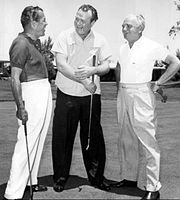
The 18-pigsty, par-72[49] Desert Inn Golf Club opened in 1952. Initially, Dalitz had pushed the idea of opening a golf course next to the hotel with an entrance off the Strip, which would exist accessible to other hotels and boost the metropolis's profile every bit a resort destination. When other hotel owners rejected this idea, Dalitz built the form on the hotel premises.[55] He too opened an outdoor dining area, to accommodate golfers and swimmers who might adopt a more informal atmosphere.[56] The course hosted the PGA Bout Tournament of Champions from 1953 to 1966,[45] attracting professional golfers such every bit Sam Snead, Arnold Palmer, and Jack Nicklaus.[55] Allard Roen was manager of the tournament for many years, and was instrumental in breaking downwardly the racial barrier on the Strip. He bankrupt the all-white club convention by permitting Sammy Davis, Jr. to play on the form.[57] From 1958 it hosted the Golf Cup Golf Tournament, the largest tournament in the world for apprentice golfers.[58]
According to the Las Vegas Sun, the grade "held the stardom of beingness the simply golf course in the United States to have annually hosted three championship bout events – the PGA Tour's Las Vegas Invitational, the Las Vegas Senior Classic and the LPGA Las Vegas International".[58] The Panasonic Las Vegas Invitational, now the Las Vegas Invitational, returned to the Desert Inn in 1983, and became known equally the wealthiest PGA event in the globe. It has since been won by the likes of Fuzzy Zoeller, Curtis Foreign, Greg Norman, and Paul Azinger. The Las Vegas Senior Archetype effect at the Desert Inn was added to the Senior PGA Tour in 1986, and has since been won by Bruce Crampton (1986), Al Geiberger, who equaled the grade record at the time of 62 (1987), Larry Mowry (1988) and Lee Trevino (1992).[58]
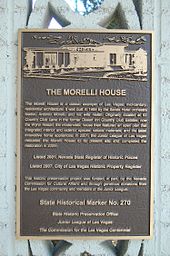
Wilbur Clark was the offset to build a home on the golf game form in the 1950s.[12] Additional homes were added to the Desert Inn Country Order Estates from the 1960s on. During his ownership of the hotel, Howard Hughes built 100 residential units on the holding.[59] After Steve Wynn purchased the resort in 2000 and announced that the real estate was too valuable to leave every bit a golf game course, homeowners were forced to sell their properties to Wynn and his property developer Irwin Molasky. Molasky bought homes closest to the golf grade for $2 one thousand thousand each, and homes on the perimeter of the resort for $900,000 to $one.2 one thousand thousand each. The Junior League of Las Vegas convinced Wynn to save one house from demolition and moved it to a lot in downtown Las Vegas to serve as its headquarters.[34] [lx] This was the Morelli Business firm, designed by architect Hugh Taylor for Antonio Morelli, a "rare instance of modernist compages in Las Vegas".[60] The firm was subsequently listed on the Metropolis and State historic registers.
Performances [edit]
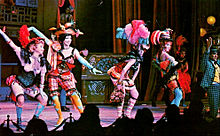
The Hello America Revue in the Crystal Room of the Desert Inn, 1967
About every major star of the latter one-half of the 20th century played at the Desert Inn. Frank Sinatra made his Las Vegas debut at the Desert Inn on September 13, 1951. He later said of information technology: "Wilbur Clark gave me my commencement job in Las Vegas. That was in 1951. For six bucks you got a filet mignon dinner and me".[11] Noël Coward performed at the Inn on ane occasion for an entire month.[7] In 1954, after a performance at the Desert Inn, Betty Hutton announced one of her several retirements.[61] In 1958, Tony Martin was signed to a five-yr deal at $25,000 per week, making him the highest paid performer in Las Vegas.[62] Eddie Fisher was heckled by a disguised Elizabeth Taylor during a 1961 performance,[63] in a yr which saw Dinah Shore booked for her fourth performance and debut Vegas performances at the Desert Inn by both Benny Goodman and Rosemary Clooney.[64] In 1979, Jet magazine noted that Wayne Newton was "enthroned" at the Desert Inn as king of amusement idols", earning $10 million a year, which made him the highest-paid nightclub performer of all time.[65] Other performers in its famous "crystal showroom" over the years included Patti Page,[66] Ted Lewis,[44] Joe E. Lewis,[67] Bobby Darin,[68] Jimmy Durante,[22] Tony Bennett,[69] Paul Anka,[70] Dionne Warwick,[71] Louise Mandrell,[72] and more than.
Louis Prima and Keely Smith recorded their 1960 Dot Records LP On Stage live at the Desert Inn.[73] Bobby Darin'southward famous anthology Live! At the Desert Inn was recorded at the hotel in Feb 1971.[68] In 1992, a week-long celebration of Frank Sinatra's 77th altogether at the Desert Inn was held[74] and subsequently in January information technology was announced that Sinatra, Liza Minnelli, Paul Anka, Shirley MacLaine, Dean Martin, Steve Lawrence and Eydie Gorme had all signed a ii-year appointment like-minded to perform at least five weeks annually.[75]
Moving picture and boob tube [edit]

Archetype image of Wilbur Clark'southward Desert Inn, 1955
Portions of Ocean'southward 11 were shot at the Desert Inn. It is one of the v Las Vegas hotels robbed on New year's day'south Eve by the characters played by Frank Sinatra, Dean Martin and others in the film.[76] Orson Welles' film F for False covers, among other topics, the scandal of a fake biography of Howard Hughes, and the billionaire'south Desert Inn residence is illustrated by Welles.[77] In the 1985 film Lost in America, Julie Hagerty's character Linda Howard loses the couple'due south "nest egg" at the Desert Inn, leading to a memorable scene in which Albert Brooks' character David Howard tries to convince the Casino manager (Garry Marshall) to give them their money back. David, an ad man, proposes a campaign centered around the generosity of the casino in his case, replete with a jingle: "The Desert Inn has center... The Desert Inn has heart."[78] The opening scene to the 1993 film Sister Human activity ii: Back in the Habit took place in the Grand Ballroom of the hotel.[79] The Desert Inn saw its concluding commercial use in the 2001 flick Rush 60 minutes 2, shortly before information technology was imploded.[80] It was converted into the "Blood-red Dragon", an Asian-themed casino ready.[81]
The hotel served every bit the primary backdrop for the Television receiver show Vega$ which aired on ABC from 1978 to 1981.[82] [83] The 1980s Aaron Spelling soap opera Dynasty included footage of the hotel, and use of the Presidential Suite.[84] The hitting 1980s NBC TV series Remington Steele filmed its 60th Las Vegas-fix episode at the inn, where both the exterior and interior are shown regularly throughout the episode.[85]
Legacy [edit]
The closure of the Desert Inn in 2000 and subsequent demolition was unpopular with many equally it seemed to mark the end of old Las Vegas. Historian Michael Green stated: "To a lot of people outside of Las Vegas, these two places (the Desert Inn and the Sands) really meant Las Vegas. These were the places that correspond the images of Las Vegas, in a far greater manner than the Dunes, the Aladdin, the Hacienda and the Landmark".[86] Robert Maheu, Howard Hughes's head of Nevada operations and publicist for many years, remarked that the "Desert Inn was the gem of Las Vegas". The hotel remained pop with locals until the end, as the heavily tourism-driven modern Las Vegas emerged in the 1990s.[87]
Desert Inn Route [edit]
Desert Inn Road is a 17¼ mile west–east road part of the Las Vegas Valley grid road arrangement. It travels through residential, commercial, and industrial areas and exists as a major thoroughfare in the surface area. At the Las Vegas Strip exists a 2½ mile expressway portion of the road officially called the Desert Inn Road Super Arterial that acts an arterial road between Winchester and Paradise. The motorway opened in 1996 and had a construction cost of Us$84 1000000.[88]
References [edit]
Citations [edit]
- ^ "Wynn Buys Desert Inn as Souvenir for Wife". Los Angeles Times. April 28, 2000.
- ^ Matuszewski, Erik (November 12, 2018). "Wynn Golf Gild In Las Vegas To Re-Open In 2019 Afterward Being Closed For Development". Forbes . Retrieved Dec 15, 2018.
- ^ a b Bulkin 1996, p. 49.
- ^ a b Kaplan 2010, p. 242.
- ^ a b Rothman 2015, p. 13.
- ^ Denton & Morris 2010, p. 62.
- ^ a b c d e f yard Fox 2007, p. 31.
- ^ a b c Russo 2008, p. 206.
- ^ Koch, Ed; Manning, Mary; Toplikar, Dave (May 15, 2008). "Showtime: How Sin City evolved into 'The Amusement Upper-case letter of the World'". Las Vegas Sun . Retrieved March 3, 2019.
- ^ a b c d e f thou h i j "History". A2zlasvegas.com. Retrieved December sixteen, 2015.
- ^ a b c Russo 2008, p. 207.
- ^ a b c d e f g h i j g "Wilbur Clark'due south Desert Inn Hotel History – 1950s". Classic Las Vegas. Archived from the original on April 5, 2015. Retrieved December 16, 2015.
- ^ Russo 2008, p. 208.
- ^ "How 1950s Las Vegas sold atomic bomb testing as tourism". /world wide web.si.edu/ . Retrieved February vii, 2019.
- ^ "Atomic tests were a tourist draw in 1950s Las Vegas". Bloomberg.com. Baronial 8, 2014. Retrieved February 7, 2019.
- ^ "Atomic Cocktail". diffordsguide.com . Retrieved February 7, 2019.
- ^ "Who are you lot miss atomic bomb". popularmechanics.com. April 26, 2016. Retrieved Feb 25, 2019.
- ^ "Las Vegas NV Atomic Testing Museum". roadsideamerica.com . Retrieved Feb 25, 2019.
- ^ "Existent Manor Human Buys the Desert Inn". The Ludington Daily News. Ludington, Michigan. August 17, 1959. p. one. Retrieved Dec xvi, 2015 – via Newspapers.com.

- ^ Kelley 1986, pp. 363–364.
- ^ Waldman & Donovan 1999, p. 139.
- ^ a b c d "Desert Inn". Online Nevada. Retrieved December 16, 2015.
- ^ "Governor Asks Trial of FBI for Wiretap". The Corpus Christi Caller-Times. Corpus Christi, Texas. June 29, 1966. p. 1. Retrieved Dec xvi, 2015 – via Newspapers.com.
- ^ Katsilometes, John (April 20, 2000). "Desert Inn celebrates its golden ceremony". Las Vegas Dominicus . Retrieved December xvi, 2015.
- ^ a b c "People and Events: Howard Hughes (1905–1976)". PBS. 2005. Retrieved December 13, 2015.
- ^ a b c Manning, Mary (May 15, 2008). "Howard Hughes: A revolutionary recluse". Las Vegas Sun . Retrieved December xiii, 2015.
- ^ Davies 1999, p. 39.
- ^ Davies 1999, pp. 39–forty.
- ^ "Frank Sinatra hoopla eclipses Lennon, Elvis and Billie". The Desert Sun. December 7, 2015. Retrieved December 16, 2015.
- ^ a b "Desert Inn - Las Vegas Strip".
- ^ a b Global Disinterestedness Enquiry. UBS Warburg. 2004. p. 10.
- ^ "Sun Will Buy Desert Inn for $275 Meg". Los Angeles Times. May nineteen, 1999.
- ^ Leong, Grace (September ix, 1999). "Sinatra manor sues Desert Inn". Las Vegas Sunday . Retrieved December sixteen, 2015.
- ^ a b "Wilbur Clark'southward Desert Inn Hotel History (connected)". Classic Las Vegas. Archived from the original on December 22, 2015. Retrieved December 16, 2015.
- ^ "Wynn'southward Plans for Desert Inn Revealed". The Los Angeles Times. August 28, 2001. Retrieved December 17, 2015.
- ^ Garman 2010, p. 278.
- ^ Easterling 2005, p. 160.
- ^ "Wynn plans water theme at DI site". Las Vegas Dominicus. August 23, 2001. Retrieved December 16, 2015.
- ^ "The Desert Inn Implosion". Las Vegas Dominicus . Retrieved December sixteen, 2015.
- ^ "Jac Lessman 85, Dies; Hotel-Resort Developer". The New York Times. November eight, 1990. Retrieved December 12, 2015.
- ^ Moehring 2003, pp. 14–xv.
- ^ Zook, Burke & Sandquist 2009, p. 134.
- ^ Architect and Engineer 1950, p. 15.
- ^ a b Jet Age Airlanes. Ayre Publishing Visitor. 1965.
- ^ a b Casino Periodical: National ed. Casino Journal of Nevada, Incorporated. January 2000.
- ^ Woods, Lanier & Zoeller 1992, p. 149.
- ^ Castleman 1999, p. 84.
- ^ a b c d e f g "Wilbur Clark'southward Desert Inn Hotel History (continued)". Archetype Las Vegas. Archived from the original on December 22, 2015. Retrieved December 16, 2015.
- ^ a b Michele and Tom Grimm (October 1992). "The West's Hottest Desert Resorts". Orange Coast: 88.
- ^ McDowell, Edwin (June 29, 1993). "Company NEWS; ITT Buying Desert Inn In Las Vegas". The New York Times . Retrieved Dec 16, 2015.
- ^ a b "Living it Upwards and Doubling Down in the New Las Vegas". The New York Times . Retrieved December 16, 2015.
- ^ Fourth dimension Out Las Vegas . Penguin. 1998. p. 84. ISBN978-0-14-027062-4.
- ^ Strow, David (April 24, 2000). "Desert Inn marks 50th ceremony". Las Vegas Sunday . Retrieved December sixteen, 2015.
- ^ "Record Megabucks jackpot hitting at Desert Inn". Las Vegas Sun. Jan 27, 2000. Retrieved December xvi, 2015.
- ^ a b Davies 1999, p. 32.
- ^ "Las Vegas Inn Opens Patio for Outdoor Dining". The Brooklyn Daily Eagle. Brooklyn, New York. June 8, 1952. p. xix. Retrieved December 16, 2015 – via Newspapers.com.
- ^ "Desert Inn, Stardust main helped integrate Las Vegas Strip". Las Vegas Sun. September 1, 2008. Retrieved Dec 16, 2015.
- ^ a b c "Desert Inn rich in tradition". Las Vegas Sun. October 20, 1997. Retrieved December xvi, 2015.
- ^ Moehring 2003, p. 55.
- ^ a b Schumacher, Geoff (April 17, 2003). "Cover story: This old town". Las Vegas Mercury . Retrieved December 17, 2015.
- ^ "The End". Pampa Daily News. Pampa, Texas. Nov 11, 1954. p. 1. Retrieved December 16, 2015 – via Newspapers.com.
- ^ "Tony Martin'south $one,000,000 Bargain". Variety. November 19, 1958. p. 1. Retrieved July viii, 2019 – via Archive.org.
- ^ "Heckler Disguised". The Oneonta Star. Oneonta, New York. June 15, 1961. p. 1. Retrieved December 16, 2015 – via Newspapers.com.
- ^ "Summit Names Booked for Desert Inn". Independent. Long Beach, California. March 16, 1961. p. 70. Retrieved Dec sixteen, 2015 – via Newspapers.com.
- ^ Vegas Idol Wayne Newton Calls Lola Falana Bear witness Biz 'Decathlon Creative person' . Jet. Johnson Publishing Company. May 17, 1979. p. 22. ISSN 0021-5996.
- ^ Electric current Biography Yearbook. H. W. Wilson Co. 1966. p. 310.
- ^ Winchell 1975, p. 236.
- ^ a b DiOrio 1981, p. 199.
- ^ Evanier 2011, p. 239.
- ^ Weatherford 2001, p. 40.
- ^ Racing Dove Message. 1979.
- ^ Roemer 1990, p. 100.
- ^ Larkin 2002, p. 342.
- ^ "Sinatra Marks 77th Birthday". The Titusville Herald. Titusville, Pennsylvania. January 3, 1992. p. 10. Retrieved Dec xvi, 2015 – via Newspapers.com.
- ^ "Stars Sign Contracts with Desert Inn". The Titusville Herald. Titusville, Pennsylvania. Jan 16, 1992. p. 3. Retrieved December xvi, 2015 – via Newspapers.com.
- ^ Davis & Pierce 2014, p. 86.
- ^ Graver & Rausch 2011, p. 76.
- ^ Rothman & Davis 2002, pp. 49–51.
- ^ "Sister Act 2: Back in the Habit script". Script-o-rama.com. Retrieved Dec sixteen, 2015.
- ^ Parker & Munier 2010, p. 169.
- ^ The Message. J. Haynes and J.F. Archibald. 2001. p. 174.
- ^ Spelling & Liftin 2009, p. 29.
- ^ Clarke 2004, p. 178.
- ^ Cosmopolitan. Hearst Corporation. January 1985. p. 1.
- ^ "Episode 60". Pbfiles.internet. Retrieved December 12, 2015.
- ^ "Wynn's closure of Desert Inn strikes nerve with community". Las Vegas Sun. August 25, 2000. Retrieved December 16, 2015.
- ^ "Desert Inn site carries a rich past". Las Vegas Sun. April 28, 2005. Retrieved December 16, 2015.
- ^ Schweers, Jeff (March xix, 1996). "Traffic to flow on new super arterial". Las Vegas . Retrieved March 19, 2021.
Sources [edit]
- Architect and Engineer (1950). Builder and Engineer. Vol. Issues eighty–183. San Francisco: Architect and Engineer.
- Bulkin, Rena (December 1996). Frommer'south Las Vegas, 1997. John Wiley & Sons, Incorporated. ISBN978-0-02-860917-ane.
- Castleman, Deke (1999). Compass American Guide to Las Vegas. Fodor'due south Travel Publications. ISBN978-0-679-00370-0.
- Clarke, Norm (January 8, 2004). Vegas Confidential: Norm Clarke! Sin City'south Ace Insider i,000 Naked Truths. Stephens Press, LLC. ISBN978-i-932173-26-0.
- Davis, Tracey; Pierce, Nina Bunche (April 22, 2014). Sammy Davis Jr.: A Personal Journey with My Male parent. Running Press Volume Publishers. ISBN978-0-7624-5017-6.
- DiOrio, Al (1981). Borrowed Time: The 37 Years of Bobby Darin. Running Press. ISBN978-0-89471-111-four.
- Davies, Richard O. (1999). The Maverick Spirit: Edifice the New Nevada . University of Nevada Press. p. 32. ISBN0874173272.
- Denton, Emerge; Morris, Roger (September 30, 2010). The Coin And The Power: The Rise and Reign of Las Vegas. Random House. ISBN978-ane-4090-0203-ane.
- Evanier, David (June 30, 2011). All the Things You Are: The Life of Tony Bennett . John Wiley & Sons. p. 239. ISBN978-one-118-03354-viii.
- Graver, Gary; Rausch, Andrew J. (October 28, 2011). Making Movies with Orson Welles. Scarecrow Printing. ISBN978-0-8108-8229-4.
- Easterling, Keller (2005). Indelible Innocence: Global Compages and Its Political Masquerades. MIT Press. ISBN026205079X.
- Play a trick on, William L. (2007). In the Desert of Desire: Las Vegas and the Civilisation of Spectacle. University of Nevada Press. ISBN978-0-87417-727-5.
- Garman, Rick (2010). Las Vegas for Dummies (6th ed.). John Wiley & Sons. ISBN978-0470944424.
- Kaplan, James (November 4, 2010). Frank: The Making of a Legend. Little, Brown Book Group. ISBN978-0-7481-2250-9.
- Kelley, Kitty (1986). His Style: The Unauthorized Biography of Frank Sinatra. Bantam Books Trade Paperbacks. ISBN978-0-553-38618-9.
- Larkin, Colin (2002). The Virgin Encyclopedia of Fifties Music. Virgin Books. ISBN978-ane-85227-937-0.
- Moehring, Eugene (2003). "The Sahara Hotel: Las Vegas' "Jewel in the Desert"". In Jaschke, Karin; Ötsch, Silke (eds.). Stripping Las Vegas: A Contextual Review of Casino Resort Compages. Verl.d. Bauhaus-Universität. ISBN3860681923.
- Parker, Quentin; Munier, Paula (Dec 18, 2010). The Sordid Secrets of Las Vegas: Over 500 Seedy, Sleazy, and Scandalous Mysteries of Sin Urban center. Adams Media. ISBN978-ane-4405-1194-3.
- Roemer, William F. (1990). War of the Godfathers: The Bloody Confrontation Betwixt the Chicago and New York Families for Command of Las Vegas . Donald I. Fine. ISBN978-ane-55611-193-8.
- Rothman, Hal; Davis, Mike (2002). The Grit Below the Glitter: Tales from the Existent Las Vegas. Academy of California Printing. ISBN978-0-520-22538-1.
- Rothman, Hal (Oct xv, 2015). Neon Metropolis: How Las Vegas Started the Twenty-Beginning Century. Taylor & Francis. ISBN978-1-317-95852-ix.
- Russo, Gus (Dec 12, 2008). Supermob: How Sidney Korshak and His Criminal Associates Became America's Hidden Power Brokers. Bloomsbury Publishing. ISBN978-ane-59691-898-6.
- Spelling, Tori; Liftin, Hilary (February 24, 2009). STORI Telling. Simon and Schuster. ISBN978-1-4165-8700-two.
- Waldman, Carl; Donovan, Jim (February 1, 1999). Forever Sinatra: A Celebration in Words & Images. Legends Press. ISBN978-0-9668136-0-nine.
- Weatherford, Mike (January 1, 2001). Cult Vegas: The Weirdest! the Wildest! the Swingin'est Boondocks on Earth!. Huntington Press Inc. ISBN978-0-929712-71-0.
- Winchell, Walter (October 1975). Winchell exclusive: "things that happened to me—and me to them . Prentice-Hall. ISBN978-0-13-960286-3.
- Wood, Robert S; Lanier, Pamela; Zoeller, Fuzzy (April 1992). Golf Resorts: The Complete Guide. Lanier Pub. International. ISBN978-0-89815-476-4.
- Zook, Lynn; Burke, Carey; Sandquist, Allen (March two, 2009). Las Vegas: 1905–1965. Arcadia Publishing. ISBN978-1-4396-2310-7.
External links [edit]
- Video of Desert Inn implosion, October 23, 2001
- Jac Lessman architectural records and papers, 1925-1975. Held by the Department of Drawings & Athenaeum, Avery Architectural & Fine Arts Library, Columbia Academy.
 | Wikimedia Commons has media related to Desert Inn. |
Source: https://en.wikipedia.org/wiki/Desert_Inn
0 Response to "Metropolitan Museum of Art Construction Las Vegas Strip 1965"
Post a Comment